
Lithium battery charging and protection integrated board module with 5V input, 4.2V ±1% charging cut-off, 2.5V over-discharge protection and 3A overcurrent protection, 1000mA maximum charging current, blue PCB board measuring 26 x 17 mm.
Blue
£5.58
Sale price
£5.58
Regular price
Skip to product information

 This integrated circuit board provides a complete power management solution for projects using single-cell lithium-ion (Li-ion) or lithium-polymer (LiPo) batteries. By combining a battery charger with essential protection features on a compact 26 x 17 mm printed circuit board (PCB), it simplifies the design and enhances the safety of portable electronics, DIY builds, and battery backup systems. The module requires only a 5V input—compatible with common USB ports or power adapters—to safely charge your battery while guarding against conditions that can shorten its lifespan or pose a risk.
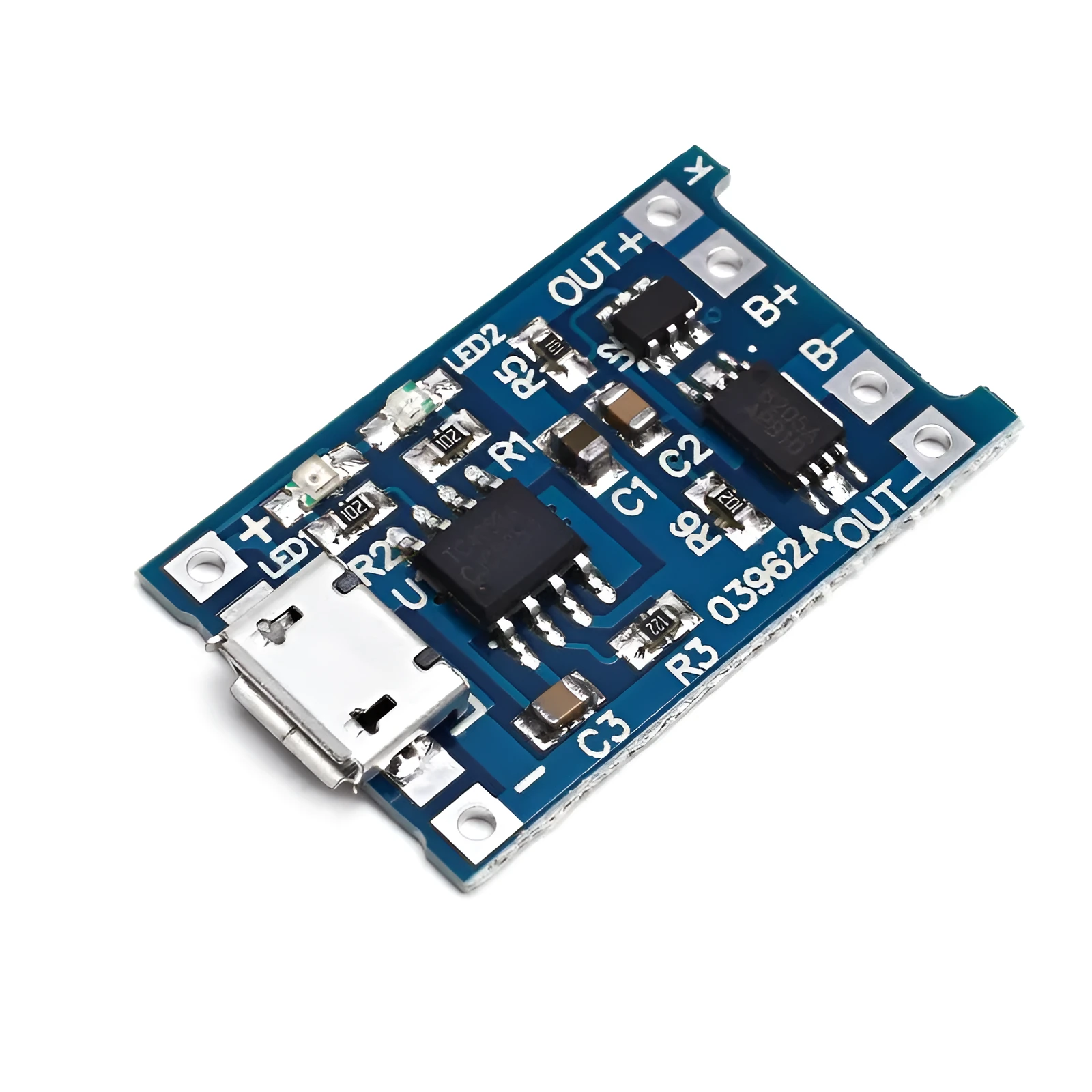 The board is engineered for 3.7V nominal lithium cells, adhering to standard charging parameters for this chemistry. Its operation is defined by several key electrical specifications that determine its performance and safety limits.
 In addition to voltage monitoring, the board includes safeguards against electrical faults. Its physical construction is tailored for reliability and ease of use in various applications.
 This integrated board is a versatile component suitable for hobbyists, makers, and small-scale commercial applications where managed battery power is needed.


Lithium battery charging and protection integrated board module with 5V input, 4.2V ±1% charging cut-off, 2.5V over-discharge protection and 3A overcurrent protection, 1000mA maximum charging current, blue PCB board measuring 26 x 17 mm.
£5.58
Sale price
£5.58
Regular price
5V Input Lithium Battery Charger and Protection Board with 4.2V Cut-off and 3A Current Protection
Technical Specifications and Charging Profile
Input Voltage and Charging Current
The module is designed to operate from a 5V DC input, a voltage widely available from USB ports, phone chargers, and many regulated power supplies. This input powers the onboard charging circuitry, which can deliver a maximum current of 1000mA (1 Amp) to the connected battery. This current level supports relatively swift charging for many common battery sizes while remaining within safe thermal limits for the board's components.Voltage Regulation and Termination
Precise voltage control is critical for lithium battery health. This board terminates the charge cycle when the battery voltage reaches 4.2V, with a stated tolerance of ±1%. This cut-off point is standard for fully charging most consumer lithium cells without overcharging them, which is essential for maintaining capacity and safety over many cycles.Protection Circuitry Voltage Thresholds
Beyond charging, the board actively protects the battery. It incorporates over-discharge protection, which disconnects the battery from the load when its voltage drops to 2.5V. This prevents deep discharge, a condition that can cause irreversible chemical damage to lithium cells, rendering them unusable or unsafe.Integrated Protection Features and Build
Overcurrent and Short-Circuit Protection
The integrated protection circuit includes a 3A overcurrent protection threshold. If the current drawn from the battery exceeds 3 Amps, the circuit will interrupt the connection to protect both the battery's internal structure and any downstream components. This also offers a degree of short-circuit protection for the connected system.Board Dimensions and Physical Layout
Measuring 26 mm in length by 17 mm in width, the board has a minimal footprint. This compact size allows it to be fitted into tight spaces within enclosures or attached directly to battery packs. The layout includes clearly labelled solder pads for the input power connections (5V and GND) and the battery connections (B+ and B-), facilitating straightforward wiring.Component Quality and Assembly
The board is supplied as a fully assembled unit, with surface-mount technology (SMT) components soldered onto a blue fibreglass PCB. This pre-assembly ensures correct component placement and soldering, providing a ready-to-use module that requires only the user to solder wires to the connection points.Practical Applications and Usage Guidance